
The Streamtime Alternative Built for Agency Quoting and Resource Scheduling
You do not leave Streamtime because it is bad. You leave because capacity becomes guesswork.
Quote with provable capacity before you send the proposal. That certainty is what gives studio managers breathing room — and predictable weekends.
Enterprise infrastructure. Agency precision. Lumen brings the quoting exactness a creative agency needs to Zoho Projects — without exposing your team to the parts of Zoho that have nothing to do with them.
- Stop double-promising senior time. See committed and tentative capacity side by side before the proposal goes out.
- Eliminate the post-win rebuild. The quote converts into a Zoho Projects plan with phases, tasks, owners, dates, and budgets in one action.
- Catch collisions before they cost you. Model what happens if two or three quotes convert in the same week, while you can still act.
Why Studios Replace Streamtime
Studios usually start searching when one or more of these becomes true:
- Quoting becomes a guessing game. You cannot confidently tell whether the right people are free in the weeks the work lands.
- Wins start colliding. Two or three quotes convert in the same period and capacity breaks without warning.
- The plan gets rebuilt after every win. Phases, tasks, hours, and assignments get re-entered instead of converted.
- Pipeline demand stays invisible. Quotes in flight do not show up as real demand until they are signed.
- Multi-phase work needs more structure. Dependencies, constraint roles, and multi-week scheduling require a tighter plan.
If you recognise that pattern, you are not looking for a better Streamtime. You are looking for studio capacity planning software that validates capacity at the moment you quote — so you can send proposals with certainty instead of hope.
Capacity Planning at Quote Time: The Category Shift
Streamtime supports planning, roles, and dependencies. The shift happens when you need something more specific.
You need the quote itself to be a delivery plan, built at task and subtask level, with skill levels, dates, dependencies, and hours, validated against portfolio capacity while you are building it, not after.
That is the difference between scheduling work and proving capacity at quote time. It is what Lumen Quoting for Zoho Projects is designed to do.
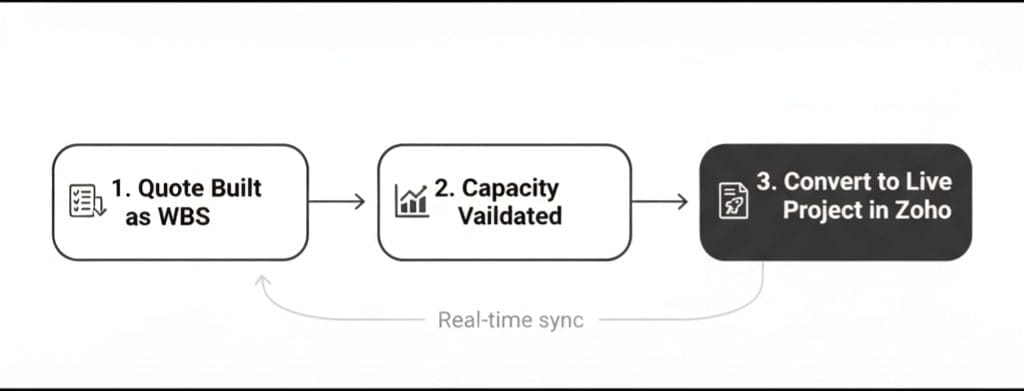
How It Works: Quote, Capacity Check, Convert to Zoho Projects
Step 1: Build the Quote as a Delivery Plan
In Lumen Quoting, you build the job at:
- Phase — Discovery, Design, Build, QA, Launch
- Task — UX Design, Frontend Dev, Content Migration
- Subtask — Wireframes, Prototype, User Testing
Each line carries the skill type and level (Junior / Mid / Senior), start and end dates, dependencies, and hours that roll up automatically from subtask to task to phase.
So you are not just estimating. You are building the plan you intend to deliver.
Step 2: Check Capacity in Real Time as You Build
Lumen Quoting checks availability as you add each line item, not after you finish the quote. For every task you can immediately see:
- Whether the right skill level is genuinely free in the specific weeks the work lands
- Whether this quote creates a conflict with live delivery
- Whether other quotes in the pipeline would consume the same capacity if they convert
- Whether committed or tentative demand is the source of the constraint
Capacity is split into two states so you always know what is real and what is at risk:
- Committed capacity — live work already scheduled and allocated in Zoho Projects
- Tentative capacity — quoted work not yet won, but still real demand that can collide
Seeing both states is what stops the “everything looked fine” problem until three proposals land at once. It also protects margin by preventing over-promising senior time.
Design Note: Callout box here — “Most tools tell you who is busy today. Lumen tells you who is busy if your top three proposals land.”
Step 3: Win the Job, Convert Directly Into Zoho Projects
When the job wins, convert the quote into a Zoho Projects plan with phases, tasks, owners, dates, and budgets in one action. No rebuild. No re-entry of the plan structure. Your team starts delivery from day one.
What You Will See in the Demo
In 10 minutes you will see the exact mechanics that make this different:
- Committed vs tentative capacity side by side (portfolio and pipeline)
- Task and subtask plan with roll-ups (hours and dates)
- Skill level demand (who can do the work, and when)
- Conflict visibility while quoting, not after signing
- Conversion flow from quote to live Zoho Projects plan in one action
Streamtime Competitor Comparison: What Changes When You Switch
What you need | Streamtime is optimised for | Lumen Quoting and Zoho Projects are optimised for |
Fast quoting and studio workflow | Simple, quick quoting and scheduling | Capacity validated quoting with structured delivery plans |
Dependencies | Dependencies are supported | Dependencies plus capacity planning at quote time |
Roles vs skill levels | Role based planning | Role and skill level planning (Junior / Mid / Senior) at task and subtask level |
Portfolio and pipeline capacity | Visibility and planning support | Committed and tentative capacity as first class inputs during quoting |
Preventing collisions | Manage workload as projects land | Model collisions before proposals go out |
Starting delivery after a win | Often involves plan refinement | Convert quote to Zoho Projects plan with phases, tasks, owners, dates, and budgets in one action |
Time tracking style | To do / drag to done feel | Timers, logged hours, and timesheets (traditional PM model) |
Finance stack (Xero / QuickBooks) | Integrations many studios like | Options via Zoho ecosystem and integration tooling (workflow dependent) |
If Invoicing Is the Main Reason You Are Switching
If your main pain is billing complexity, Lumen supports billing approaches including time billing (invoice for tracked time and expenses), fixed-fee with milestone billing (invoice when agreed deliverables land), progress billing (invoice by percentage complete), and risk controls (cap exposure with financial triggers). See the full billing page for details.
Who This Streamtime Competitor Is For and Who Should Stay
This is the right agency quoting and resource scheduling tool if:
- Multiple projects compete for the same constraint roles
- You need to know before sending the proposal whether capacity is real
- Pipeline conversions can land together and you need to see the collision risk early
- You are tired of rebuilding delivery plans after every win
- You want the quote and the project plan to be the same thing
You may be better staying on Streamtime if:
- Your team is small and your pipeline is simple enough for rough checks
- Your workflow is built around Streamtime’s style of time tracking and you do not want to change
- You want the lightest possible setup and minimal structure
Find out how Lumen's Quote for Zoho Projects checked in real time against every live project and every other quote in your pipeline, before the proposal goes out.
Don’t settle for less – partner with Lumen Business for an experience that drives your business forward.
Migration and Onboarding: What the Switch Actually Looks Like
Moving to a new quoting and project system feels heavier than it usually is. Here is what onboarding with Lumen actually involves.
Lumen is the layer that gives Zoho Projects the quoting precision a creative agency actually needs. Your team works inside Lumen for quoting and inside Zoho Projects for delivery — they are not navigating the full breadth of the Zoho ecosystem unless they choose to.
We set up your roles, skill types, and levels once so capacity checking reflects how your team is actually structured, not generic availability. Your phases, task templates, and dependency logic are configured before you quote your first job. Most studios are quoting in the new system within a few weeks of starting onboarding.
Your historical Streamtime data does not need to be migrated for Lumen to work. Active projects can be entered as committed capacity so your portfolio load is accurate from day one. If you are mid-project on several jobs, we will work through the transition plan with you during onboarding so nothing falls through the gap.
The Cost of the Wrong Studio Capacity Planning Software
Every quote that goes out without real capacity behind it carries hidden risk.
When the same Senior person is implicitly promised across multiple proposals in the same week, you do not feel the damage until delivery, when the client has signed and your options are expensive: paying a premium for freelancers, slipping dates, or burning out the team.
The right Streamtime replacement changes when you discover constraints, from mid delivery to pre proposal, while you can still act. That shift is what turns capacity planning from a source of anxiety into a source of confidence.
Streamtime Alternative for Capacity-Driven Studios FAQs
Do we lose Streamtime style time tracking?
Zoho Projects uses timers and logged hours against tasks. It is a different feel from Streamtime’s approach. The demo will make the difference obvious.
We use Xero. What happens?
We have documented workflows for Xero and Zoho reconciliation that we will tailor to your billing cycle during onboarding. If you stay on Xero, your Zoho finance workflow can connect via integration tooling depending on how you invoice and reconcile.
Do we need to be on Zoho already?
Lumen Quoting runs inside Zoho Projects and can also run inside Zoho CRM. Moving onto Zoho is part of the transition if you are not already there.
How heavy is the setup?
We set up your roles and skill levels once during onboarding so capacity checking reflects how your team is actually structured, not generic availability.
See If Lumen Is the Right Streamtime Replacement for Your Studio
If your real problem is capacity planning at quote time, the demo will show it in minutes. Most studio managers leave knowing exactly whether this gives them the certainty and breathing room they have been looking for.
